
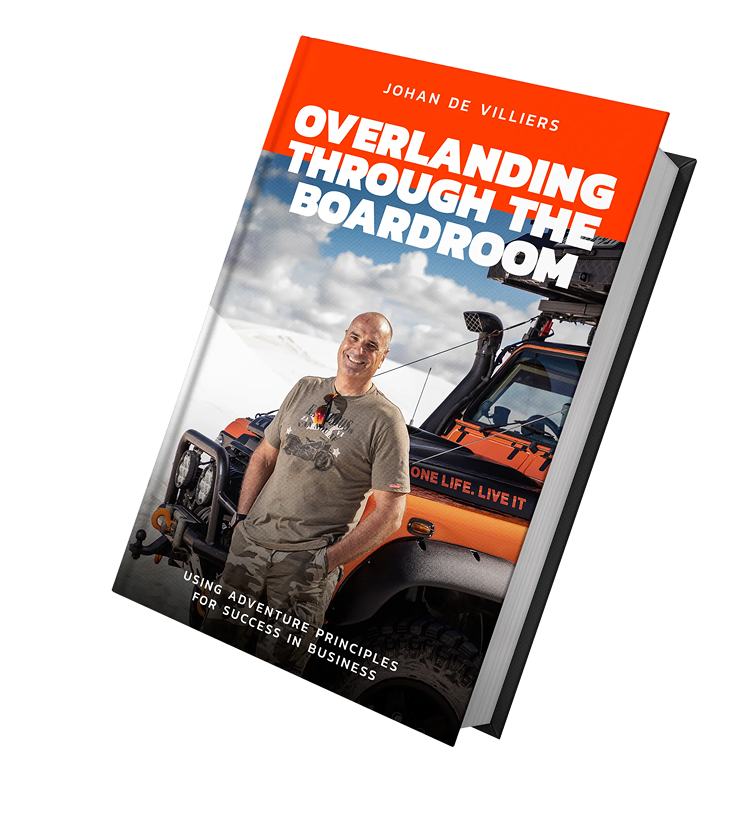
The preparation, attitude, risk evaluation and problem solving skills you take with you into the wild could save your life or a teammate's life. Many of the same qualities will make the difference between a good business leader and a great one. This year, venture into uncharted territory with Johan, as he publishes Overlanding Through the Boardroom, his unique take on the direct and practical applicability of adventure on developing a bold, creative, and resilient approach to business leadership. It's a must-read for anyone determined to be a success, however they define it.
INSIDE THE EXPEDITION

CHAPTER 1
The Principles of Overlanding and Their Application to Business Success
The chapter opens at Mana Pools - the Big Five reserve in Zimbabwe where they hand you an indemnity form at the gate and promise to come and collect what’s left of you. A Pajero rolls in from Gauteng one evening, gold-dripping, on-road tyres, towing a Venter trailer with a Defy chest freezer full of steaks. Hyenas drag the freezer 100 metres into the bush that night and chew through the aluminium casing. The first rule I made up after that trip: think very carefully about who you choose to overland with. The principles that follow - awareness, preparedness, willingness - apply just as cleanly to who you let into a boardroom.


CHAPTER 2
Lessons from a Heli Pilot and the Swiss Cheese Effect
After we sold our IT business in 2007, I went to flight school. Helicopters teach you that disasters don’t arrive - they assemble. Weight and balance, fuel reserves, pre-flight checks, weather, comms. James Reason called it the Swiss Cheese Effect: every layer has holes; catastrophe happens when the holes line up. The chapter ends with the West Coast Baja in 2017, where a tired rider, a satellite phone Kim almost left at home, the wrong GPS coordinate format, and 50°C (122°F) heat all aligned. Gary Rowley died in her arms that day. The chapter is dedicated to him, and to the layers we still owe him.

CHAPTER 3
The Dunning-Kruger Effect
A lime-green Suzuki Jimny, a pitch-dark night near Mulanje in Malawi, an 80-metre stretch of mud, and ten pairs of white eyes watching us from the trees. We winged the crossing. The Jimny - which I had quietly written off the moment we picked her up - sailed through it like a dog with a ball, then wagged her muddy tail at me on the other side. That’s the anchor: the moment your confidence and your competence aren’t the same thing, and you don’t always know which one is driving. Dunning-Kruger in business looks identical - only the cost is project failure, lost staff, and a balance sheet no one wants to look at.

CHAPTER 4
Black Swan Events
Mount Elbrus, summer 2013. A storm that wasn’t on any forecast dropped the temperature from -6°C to -30°C (-22°F) in an afternoon, with 55-knot winds and a whiteout that swallowed the marker poles. Kim’s hand went numb. The Russians sent a Snowcat for a price that would have bought a small car. I’d have paid ten times that. Two days later, on summit day, we watched a climber 100 metres ahead of us get lifted off the mountain by a single gust. Taleb’s three criteria for a black swan - rare, devastating, obvious in hindsight - fit both events exactly. The chapter argues your business plan should assume them.

CHAPTER 5
The Psychology of Sales and the Importance of Team Selection
Four personality types walk into a Porsche dealership: the Director already knows the model and colour; the Emotive needs to feel the leather and hear the turbo; the Scientist wants the brochure cross-referenced against the brochure; the Amiable agrees with everything and buys nothing. Misread the type in the first thirty seconds and you’ll burn weeks on the wrong close. The chapter then heads north to a Maasai warrior with a spear who guarded our camp for $2 a night through the freezing dark - and shows why selling to a tribe and selling to a board of directors run on the same three buttons.

CHAPTER 6
Importance vs Urgency
The Saturday afternoon trap: you’re finally backing up the photos you’ve been meaning to back up for years, the phone pings, your friend tells you the T-shirt sale ends in an hour, you’re out the door before you’ve thought about it, and an hour later you own ten T-shirts and a still-broken photo library. That’s importance versus urgency in one panic. The chapter walks through the Eisenhower matrix, applied to actual decisions in a boardroom and on a life raft. The hardest skill to learn - and the one that compounds the fastest - is saying no to other people’s self-imposed emergencies.

CHAPTER 7
The Age of Acceleration: How to Prepare for the Fourth Industrial Revolution
February 2019, an Anura Malbec on a Sunday afternoon, and a half-formed idea: dirt biking through Myanmar. I called the only operator I could find - a man with a heavy Russian accent who took payment upfront, dropped two brand-new Honda CRF250s at our hotel in Mandalay, and told me to "go vest and keep ze sun on your back." 2,500 kilometres (1,563 miles) later, navigating on Google Maps and chains lubed with toothbrush-applied gearbox oil. The chapter zooms out from there to the Fourth Industrial Revolution - why adaptation, not expertise, is the survival skill of the next decade.

CHAPTER 8
Volume vs Value in Business
The Okavango shortcut that nearly drowned our Landy when the floodwaters arrived three weeks early. We swapped seats mid-marshland - Kim was small enough to clamber over the fridge, and I needed to reverse 1,500 metres along a submerged jeep track on side mirrors only. That’s the anchor for the Business Portfolio Matrix - Core, Commoditised, Specialised, Augmented - and the A/B/C client model that’s run my account books for fifteen years. A clients are marriages. B clients are dates. C clients are crabs in a pot, and they get electronic-only contact. Volume keeps the lights on. Value pays for everything else.

CHAPTER 9
The Art of War
Sun Tzu wrote two thousand years ago about subduing the enemy without fighting - the most underused move in any modern boardroom. The chapter walks through The Art of War’s actual battlefield principles (deception, terrain, the golden bridge for a retreating opponent, the ratio of strategy to tactics) and lands them where they belong: investment strategy in a crashing market, competitive positioning, knowing when to fight and when to walk. Sun Tzu would have eaten modern consultants alive. "Strategy without tactics is the slowest route to victory. Tactics without strategy is the noise before defeat." Both halves are needed, and most operations have only one.

CHAPTER 10
Avoiding Day 2
Bezos rang a bell for Amazon’s first sale in 1995. By 2016, he was warning his own staff against the slow death of Day 2 - the company that’s stopped feeling like Day 1. Day 2 starts subtly: you stop visiting your clients because you assume they’re committed; the bureaucracy you built to scale starts running you instead. Less than 2% of the S&P 500 from fifty years ago is still on it. The rest got eaten by Day 2. The chapter is about how to stay angry, hungry, and customer-obsessed long after you’ve earned the right not to be.

CHAPTER 11
Applying Stoicism in Your Life
After two weeks in the Cambodian rainforest, we ended up on a six-hour gamble with a man called Mr Moon - a $50 round trip in his white Toyota Camry to the Sihanoukville coast - followed by a ferry that wasn’t there when we needed it and a snoekskuit chartered for $100 to get us back across the South China Sea before our flight home. Mr Moon was waiting where he said he’d be, three days later, no contact in between. The chapter uses that trip to unpack Marcus Aurelius and Seneca - what you can control, what you can’t, and why rehearsing the worst case is a planning tool, not a depressive habit.

CHAPTER 12
Ray Dalio’s Principles
Easter 2017. The Monster’s gearbox died 60 km (38 miles) south of Calvinia in the Tankwa - deep gravel, no cell reception, three-week trip ended in twenty-four hours. The farmer whose property we walked onto recognised me - First Technology had shipped hay bales to his neighbours during the 2015 drought. Sometimes what you give out comes back. The chapter pivots from there to Ray Dalio at Bridgewater: Radical Truth, Radical Transparency, Idea Meritocracy, believability-weighted decision-making. The hard sell is honesty in environments built to reward politeness. The easy line: if you can’t say it to the room, the room is the problem.

CHAPTER 13
The Power of Adaptation
Iceland, 2015. Five glaciers - Vatnajökull, Langjökull, Hofsjökull, Mýrdalsjökull, Drangajökull - climbed roped to strangers six metres apart, ice axes ready to arrest a fall through a hidden crevasse you can’t see until you’re in it. The Icelanders adapt to that landscape with grass roofs, geothermal heat, and a casual attitude to cliff edges that South Africans find mildly alarming. The principle the chapter teaches is SIPDE - Scan, Identify, Predict, Decide, Execute - taught in advanced driver training and applicable to almost any environment where the conditions outpace the rule book. Including the average Monday morning.

CHAPTER 14
Disruptive Innovation
Christensen’s framework: the new entrant arrives cheap, simple, and frankly worse than the incumbent’s product. The incumbent sneers. The entrant moves upmarket. By the time the incumbent looks up, the customer has switched. The chapter walks through the obvious cases - Kodak, Blockbuster, Nokia - and the less obvious ones, like Netflix walking away from its own DVD business before anyone forced it to. The thread is the same: most companies aren’t killed by their competitors. They’re killed by their reluctance to disrupt themselves while they still have the runway to do it. By the time the runway runs out, so do the options.
"The map is never the territory. The best leaders are those who've learned to navigate both the boardroom and the bush — where risk is real, and lessons are earned, not read."
WHAT YOU'LL LEARN

Dunning-Kruger Effect
How overconfidence blinds us - and how self-awareness saves us.

Black swan theory
Preparing for the unpredictable in business and the bush.

The Art of War
Ancient strategy applied to modern leadership challenges.

Stoicism
Control, acceptance, and resilience under pressure.

Ray Dalio's principles
Radical transparency and systematic decision-making.

Strategic decision-making
Frameworks for high-stakes choices in uncertain environments.
CONNECT WITH US